- Address:Zhengzhou, Henan, China
- Mon-Fri (8am - 6pm)
- sales@alummc.com

Aluminum Sheet Thickness for Spirit Bottle Caps
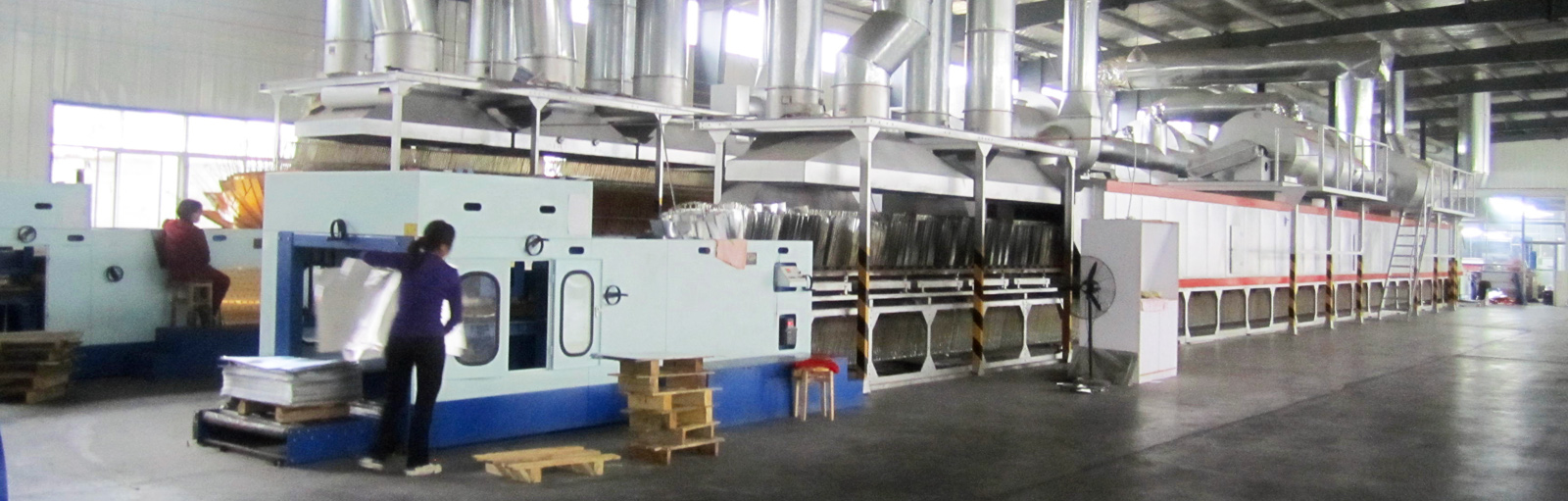
As a manufacturer of bottle cap aluminum sheet, we understand that sheet thickness is one of the most important specifications in spirit bottle closure production. It directly affects deep drawing performance, thread formation, cap rigidity, sealing reliability, decoration quality, and material consumption. For whisky, vodka, rum, gin, brandy, and other premium spirits, the aluminum closure must provide both dependable technical performance and a refined external appearance.
The suitable aluminum sheet thickness for spirit bottle caps is not determined by cap diameter alone. It must be selected together with alloy, temper, cap height, thread design, tamper-evident band geometry, liner type, forming equipment, and surface finishing process. In our rolling and slitting production, we evaluate these factors as a complete manufacturing system rather than as isolated parameters.
Typical Thickness Range for Spirit Bottle Cap Aluminum Sheet
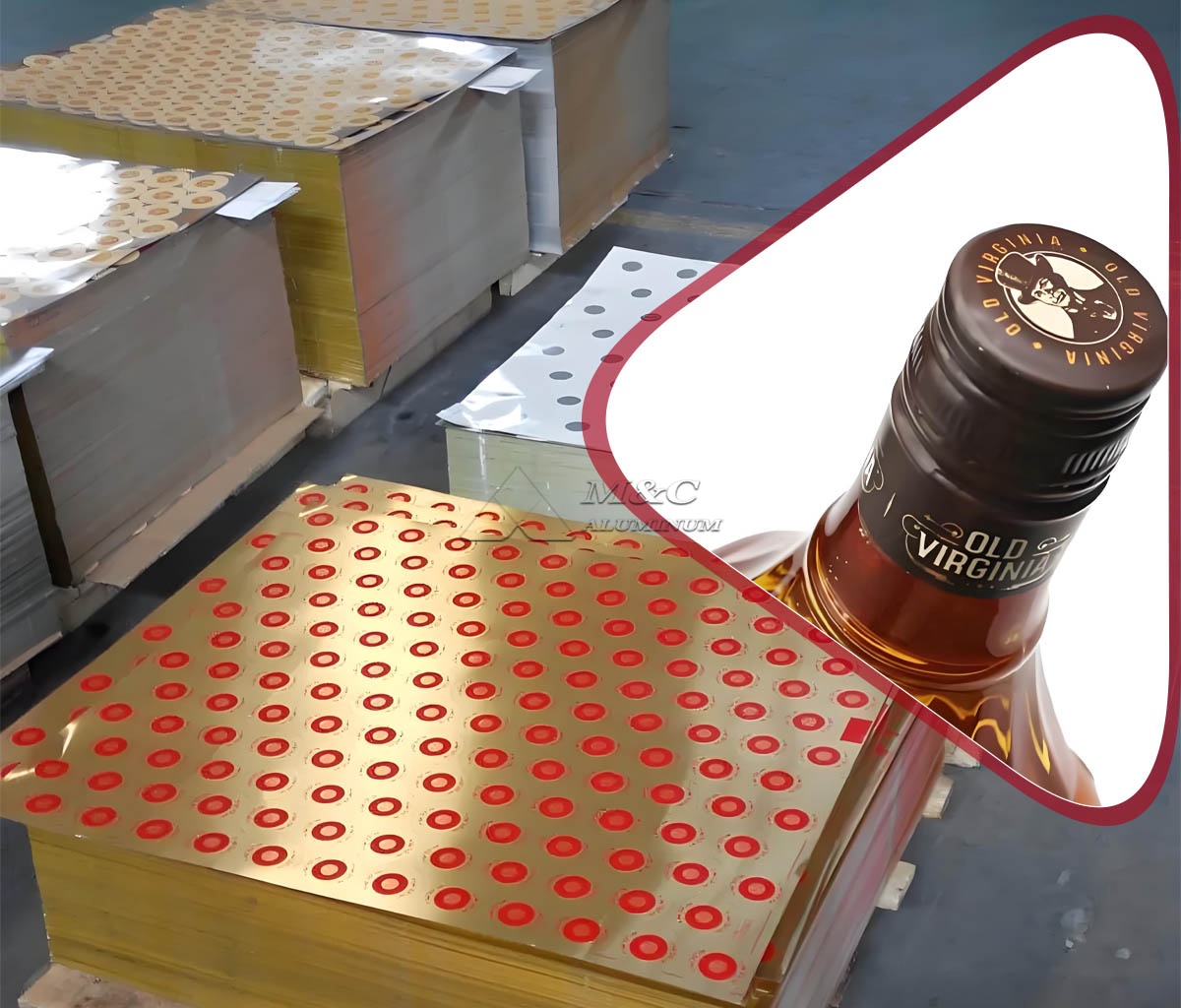
For most ROPP, screw cap, and pilfer-proof spirit closures, aluminum sheet thickness commonly falls between 0.20 mm and 0.28 mm. Within this range, 0.22 mm, 0.23 mm, and 0.24 mm are widely used specifications because they provide a balanced combination of formability, stiffness, and cost control.
Thinner material may be suitable for compact caps or closures with simpler profiles. Thicker material is generally selected for large-diameter caps, taller caps, premium heavy-gauge designs, or closures requiring increased resistance to deformation during capping, transportation, and consumer opening.
| Cap Application | Typical Aluminum Sheet Thickness | Common Alloy | Typical Temper | Main Requirement |
|---|---|---|---|---|
| Standard spirit ROPP caps | 0.22-0.24 mm | 3105 | H14, H16 | Balanced drawing, threading, and sealing |
| Lightweight spirit bottle caps | 0.20-0.22 mm | 3105, 8011 | H14 | Reduced material use with stable forming |
| Premium tall spirit caps | 0.24-0.28 mm | 3105 | H14, H16 | Higher sidewall stiffness and appearance |
| Large-diameter closures | 0.25-0.30 mm | 3105, 8011 | H14, H16 | Improved rigidity and deformation resistance |
| Decorative deep-drawn caps | 0.23-0.27 mm | 3105 | H14 | Surface quality and deep drawing performance |
These values are reference ranges. The final thickness should be confirmed through cap tooling trials and compatibility testing with the selected bottling line.
Why Thickness Is Critical in Spirit Bottle Cap Production
Aluminum closure sheet is processed through blanking, cupping, drawing, trimming, knurling, threading, scoring, liner insertion, printing, and sometimes embossing. Each step places different demands on the aluminum material.
If the aluminum sheet is too thin, the cap may lose rigidity. This can result in sidewall wrinkling, uneven thread formation, distortion at the open end, reduced torque performance, or poor visual consistency after capping. Thin material can also be more sensitive to handling damage during high-speed filling operations.
If the material is too thick, the drawing load increases and forming becomes less efficient. Excessive thickness can raise blanking and tooling wear, increase material cost, and create difficulties in detailed cap features such as score lines or tamper-evident bridges. Therefore, the best bottle cap aluminum sheet is not simply the thickest material, but the material engineered for the closure design and production process.
For standard spirit bottle caps, a thickness of 0.22 mm to 0.24 mm is often an effective starting point. This range supports stable cap forming while allowing manufacturers to maintain efficient metal utilization.
Selecting Thickness According to Cap Geometry
Cap geometry has a direct influence on thickness selection. A short closure with a moderate diameter generally requires less rigidity than a tall cap with a long skirt. Similarly, a cap with deep embossing, heavy knurling, a complex anti-counterfeit structure, or a pronounced tamper-evident band may need a carefully controlled thickness to maintain consistent feature definition.
Cap Diameter
A larger diameter increases the area of the cap shell and can reduce its resistance to deformation. For wide-mouth spirit bottles, a slightly thicker aluminum sheet may be needed to prevent ovality and maintain a clean cylindrical profile after capping.
Cap Height
Tall closures are more susceptible to denting and sidewall deformation. For premium spirits, where caps often feature extended skirts and decorative printing, thickness in the 0.24 mm to 0.28 mm range may be considered depending on the cap design.
Thread and Tamper-Evident Band Design
ROPP caps require accurate thread formation under rolling pressure. The tamper-evident band must also retain sufficient strength while separating predictably during opening. The aluminum alloy, temper, and thickness must work together to achieve this balance.
Recommended Alloys for Spirit Bottle Cap Aluminum Sheet
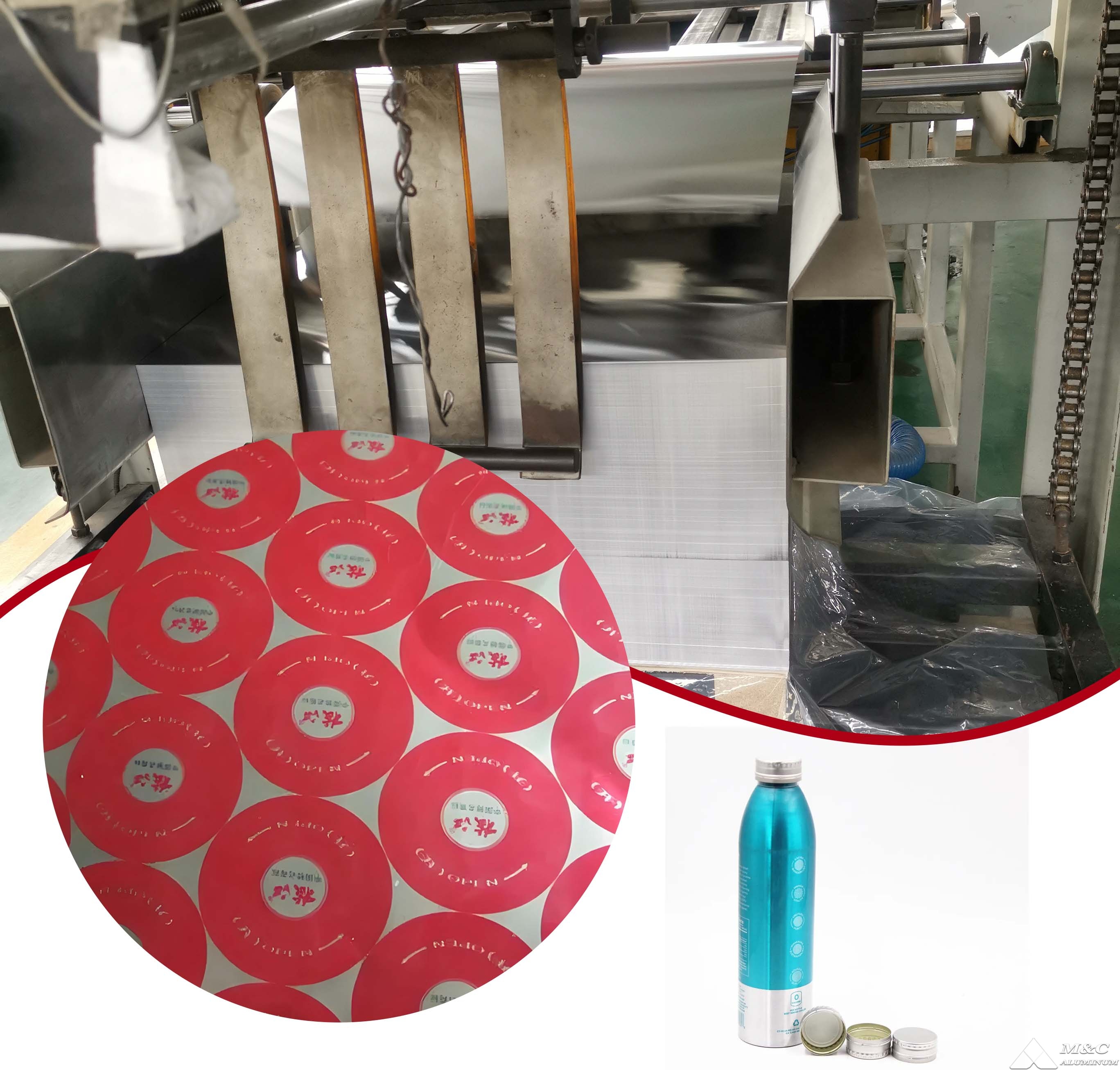
Thickness alone cannot ensure good closure performance. In our production, 3105 aluminum alloy is one of the principal materials used for spirit bottle cap applications. It has suitable strength, good corrosion resistance, and reliable formability for ROPP closure manufacturing.
8011 aluminum sheet is also used in selected closure designs, especially where good drawing capability and stable processing characteristics are required. The choice between 3105 aluminum closure sheet and 8011 aluminum sheet depends on cap geometry, equipment settings, customer quality standards, and surface treatment requirements.
| Material Property | 3105 Aluminum Closure Sheet | 8011 Aluminum Sheet |
|---|---|---|
| Typical use | ROPP caps, spirit closures, wine caps | Closure stock, deep-drawn caps, specialty caps |
| Strength level | Moderate | Moderate to relatively soft depending on temper |
| Formability | Good | Good |
| Surface quality | Suitable for coating and printing | Suitable for coating and printing |
| Corrosion resistance | Good | Good |
| Suitability for spirit bottle caps | Widely used | Used for selected closure structures |
For premium spirit closures, we commonly recommend starting material selection with 3105 alloy in H14 or H16 temper, followed by validation on the actual cap-making line.
Temper and Mechanical Properties Must Match Thickness
The temper affects how the aluminum sheet responds during drawing and threading. Even when thickness is correct, an unsuitable temper can cause cracking, wrinkling, uneven threads, or inconsistent cap dimensions.
A softer temper generally improves formability but may reduce finished cap rigidity. A harder temper can improve resistance to deformation but may limit drawing performance, particularly in caps with a tall skirt or deep profile. In practical production, H14 is frequently selected because it provides a workable balance between elongation and strength.
| Parameter | Typical Control Range for Spirit Cap Stock | Production Importance |
|---|---|---|
| Thickness tolerance | Controlled according to customer specification | Supports stable blanking and drawing |
| Alloy | 3105 or 8011 | Determines strength and formability balance |
| Temper | H14, H16, or specified temper | Influences drawing and thread rolling |
| Surface cleanliness | High and uniform | Protects coating adhesion and print quality |
| Flatness | Controlled for coil processing | Reduces feeding and stamping instability |
| Edge quality | Burr-controlled slit edge | Helps prevent defects during blanking |
The exact mechanical property range should be agreed based on the cap maker's tooling, cap dimensions, and line speed. We control rolling, annealing, leveling, and slitting parameters to support stable downstream conversion.
Coating and Printing Considerations
Spirit bottle caps often serve as an important branding element. They may use solid colors, metallic finishes, matte coatings, high-gloss coatings, embossed logos, or multi-color printing. The aluminum sheet must therefore provide not only formability, but also a uniform surface suitable for coating and decoration.
Thickness variation can affect coating consistency and cap appearance after forming. A stable gauge profile supports more uniform drawing behavior, reducing the risk of local distortion that can affect printed graphics or lacquer coverage.
For coated bottle cap aluminum sheet, surface treatment must be compatible with the selected coating system. The coating should resist scratches, alcohol exposure, moisture, and handling abrasion while retaining adhesion after cap forming. For spirit closures, this is especially important because premium packaging frequently requires a high-quality visual finish throughout distribution and retail display.

Thickness Control During Aluminum Sheet Manufacturing
As an aluminum sheet manufacturer, we control thickness through the full production route, from raw material preparation to final coil inspection. The process includes melting and casting, hot rolling, cold rolling, annealing where required, tension leveling, slitting, and packaging.
Cold rolling is particularly important for achieving the specified gauge and surface finish. During this stage, rolling force, reduction schedule, lubrication, strip tension, and roll condition must be carefully managed. We also monitor thickness across the strip width because cross-profile variation can influence cap forming consistency.
After rolling, the coil is inspected for thickness uniformity, flatness, surface defects, edge condition, and coil geometry. For bottle cap aluminum sheet, stable coil quality is essential because cap makers often operate high-speed presses where even minor material inconsistency can affect production efficiency.
How to Confirm the Correct Thickness Before Mass Production
Before approving a specification for large-volume supply, we recommend evaluating the aluminum closure sheet through production trials. The testing process should include blanking, drawing, trimming, threading, knurling, scoring, liner insertion, capping, torque testing, and opening performance assessment.
Key evaluation points include the following:
Cap sidewall smoothness and absence of wrinkles.
Thread definition and compatibility with the bottle finish.
Tamper-evident band separation performance.
Cap torque retention and sealing reliability.
Resistance to dents during handling and transport.
Coating adhesion, print registration, and scratch resistance.
Dimensional consistency at normal production line speed.
A practical trial can determine whether 0.22 mm, 0.23 mm, 0.24 mm, or a heavier gauge is most appropriate for a particular spirit bottle cap design.
Conclusion
The appropriate aluminum sheet thickness for spirit bottle caps is usually between 0.20 mm and 0.28 mm, with 0.22 mm to 0.24 mm widely used for standard ROPP closures. However, thickness must be selected together with aluminum alloy, temper, cap geometry, decoration process, and bottling requirements.
For reliable spirit bottle cap manufacturing, 3105 aluminum closure sheet in a controlled H14 or H16 temper is commonly used because it offers a practical balance of strength, formability, surface quality, and processing stability. By controlling gauge accuracy, flatness, mechanical properties, and surface condition, we manufacture bottle cap aluminum sheet designed to support efficient cap forming and consistent closure performance.


Applications

-
Advisory Message
Alloy Grade Thickness, Application, etc.
-
Quick Reply
Quick reply within 30 minutes
-
Getting Information
One-to-one design and customized production plan